
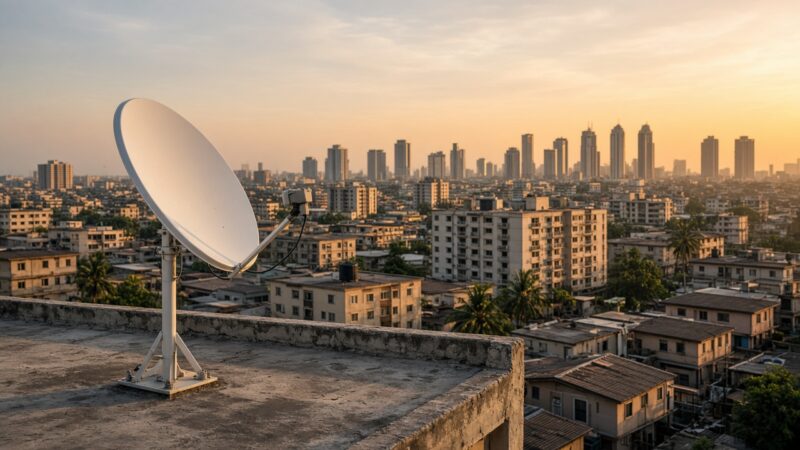
Ask around in any Lagos WhatsApp group about internet and someone will mention Starlink within three messages. Usually it is a complaint about the price, or about a waitlist that never seems to move. Sometimes it is a boast from the one person on the street who finally got a dish on the roof.
So is Starlink in Nigeria worth it in late 2026? The honest answer depends on where you live, what you do online, and how you handle light. Below is what recent Nigerian reports say about the cost, the availability problem, and who should actually pay for it. Prices here come from reports published between February and April 2026, so confirm the live figure on Starlink’s own page before you spend anything.
What Starlink costs in Nigeria
Start with the monthly fee, since that is what most people search for. Starlink’s Nigeria service-plans page shows the Residential plan at ₦57,000 a month, described as unlimited data with a 30-day trial. Tribune Online reports that this figure has not moved since June 2025, when it rose from ₦38,000.
Then there is the hardware, which is where the real shock sits. Tribune’s April 2026 breakdown puts the Standard Kit at ₦590,000 and the smaller, travel-friendly Mini Kit at ₦318,000, both one-time payments. Legit.ng, writing in February, also gives about ₦590,000 for the standard kit. Other sites quote different numbers, and the kit price follows the dollar, so treat any single figure as a guide and not a promise. Resellers on top of that will charge their own margin.
The Business Priority plan
Starlink also sells a Business Priority plan. Legit.ng reports it has been offered in Lagos, Abuja and Port Harcourt since 14 February 2026, at ₦159,000 a month, which the paper put at roughly $99. It comes with 1TB or 2TB of high-priority data a month, a public IPv4 address and better support. Data stays technically unlimited, but speeds can drop in busy periods once you pass the priority amount.
For a shop, an office or a small studio, that public IP and the priority treatment can matter. For a family that wants Netflix to stop buffering, it is a lot of money.
Why the number keeps changing
Starlink bills in naira, but its costs are in dollars. When the naira slips, something has to give. Tribune notes the standard kit is about $368, which at ₦1,580 to the dollar in March 2026 works out to roughly ₦581,000 before import costs. That is why hardware prices wobble even when the monthly plan sits still.
There is a regulatory story too. Late in 2024 Starlink announced a monthly rise to ₦75,000, and the Nigerian Communications Commission said it had not approved the increase. Legit.ng reports that a pricing dispute with the NCC stopped new residential orders nationwide for eight months, from November 2024 to June 2025. Sales came back at ₦57,000.
The real problem: getting a slot in Lagos
Money is only half of it. Plenty of Lagosians can afford ₦57,000 and still cannot order.
According to Tribune, new residential orders have been paused in high-demand areas including Victoria Island, Ikoyi, Lagos Island, Surulere and Lekki, because the network there is congested. Customers in those places are asked to pay a refundable deposit and join a waitlist, with no firm date. Legit.ng says the situation in several dense urban areas has stayed the same since September 2025.
That is the reason the Priority plan exists in the first place. If you live in a blocked area and need a connection now, the ₦159,000 route is the way in, and that is a very different budget conversation.
There is some good news. Tribune reports that Port Harcourt and Benin City opened up for residential activations after a new ground station at Okun Aja in Lagos State went live, with 20 antennas and room for 36 more. It also says that in places such as Ibadan, Enugu and Kaduna, and in most semi-rural areas, you can still order the Residential plan directly. Availability changes quickly, so enter your address on Starlink’s site to see what you are offered today.
Starlink versus 5G and fibre
Here is where it gets interesting. Tribune’s comparison lists Starlink urban speeds at 50 to 100 Mbps, against 200 Mbps up to 1 Gbps for MTN 5G and 200 to 700 Mbps for Airtel 5G. It puts Starlink’s monthly cost at ₦57,000 against about ₦15,000 to ₦30,000 for the 5G options. Those are one publication’s estimates, not lab tests, and real speeds change by street and by hour.
Read plainly: if a solid 5G or fibre line reaches your building, it will probably beat Starlink on both speed and price. Tribune says as much, noting that anyone in central Lagos or Abuja with access to MTN FibreX or Airtel fibre may get cheaper and faster service.
Starlink wins in a different spot. It does not need a cell tower or a cable on your street. If you live somewhere 5G does not reach, a dish with a clear view of the sky is often the only serious option. It also carries no data cap on the Residential plan, while mobile plans usually have fair-use limits.
Who should buy it, and who should wait
It makes sense if
You live or work outside the big urban centres, where 5G and fibre are thin or missing. You run a small business, a remote job or a studio where an hour of downtime costs you real money. You can pay ₦590,000-ish upfront without wrecking your savings. And you have a plan for power.
Think twice if
You are in an area with decent fibre or 5G. You would be paying a premium for slower speeds. Or you are in one of the blocked Lagos districts and would be tying up a deposit with no date attached.
Power, installation and the small print
Starlink needs electricity like everything else. The dish and router do not run on hope, so budget for an inverter or a decent UPS if you want the connection to survive NEPA taking light. Tribune makes the same point: the dish helps when towers go down, but only if the router stays powered.
Setup is simple by the standards of most telecom installs. Tribune says the kit includes the dish, router, mount and cables, and that you can install it yourself. The one thing to check is the sky. Trees or tall buildings in the way can hurt the signal badly, and the Starlink app has an obstruction checker you can use before you buy. Use it.
Also be careful where you buy. With a waitlist and high prices, Nigerians hunting for kits online meet sellers of all sorts. Order through Starlink’s official site where you can, and be wary of anyone offering to “skip the queue” for cash.
What could change next
Competition is on the way. Legit.ng reports that Amazon’s Project Kuiper secured landing rights in Nigeria in January 2026, and that the NCC licensed six new internet service providers from 1 January 2026, taking the total to 231. None of that means cheaper prices tomorrow. Tribune’s own view is that the monthly price is unlikely to fall without a much stronger naira or a regulatory push.
Frequently asked questions
How much is Starlink per month in Nigeria?
Starlink’s Nigeria page lists the Residential plan at ₦57,000 a month. The Business Priority plan was reported at ₦159,000 a month in February 2026. Check the official site for today’s prices, because they can change.
How much does the Starlink kit cost in Nigeria?
Nigerian reports in 2026 give about ₦590,000 for the Standard Kit and about ₦318,000 for the Mini Kit. Prices vary by seller and by the exchange rate, so treat these as estimates.
Can I get Starlink in Lekki, Ikoyi or Victoria Island?
Reports say new residential orders in those areas have been paused because of congestion, with waitlists and refundable deposits instead. The Business Priority plan has been the alternative. Availability may have changed, so check your address on Starlink’s site.
Is Starlink unlimited in Nigeria?
The Residential plan is advertised as unlimited data. On the Priority plan, data is unlimited too, but you get a set amount of high-priority data, after which speeds can slow when the network is busy.
Is Starlink faster than MTN or Airtel 5G?
Usually not, where 5G is available. Tribune’s comparison put urban Starlink speeds at 50 to 100 Mbps against much higher figures for 5G. Starlink’s advantage is coverage where 5G and fibre do not reach.
Will Starlink get cheaper in Nigeria?
Nobody can say for sure. Tribune’s April 2026 report said the monthly price had not dropped and was unlikely to without a stronger naira or regulatory action.